✉
deandan@doitscm.com
🕒
Monday – Friday, 9:00 AM – 6:00 PM (GMT)Mold Design and Manufacturing
In today’s competitive manufacturing industry, mold design and manufacturing play a critical role in
producing high-quality plastic and metal components. Whether you’re developing automotive parts,
consumer electronics, medical devices, or industrial equipment, a precision mold directly impacts product
quality, production efficiency, and overall manufacturing costs.
This guide explains the complete mold manufacturing process, from product design and engineering to
CNC machining, mold assembly, and production validation.
What Is Mold Design and Manufacturing?
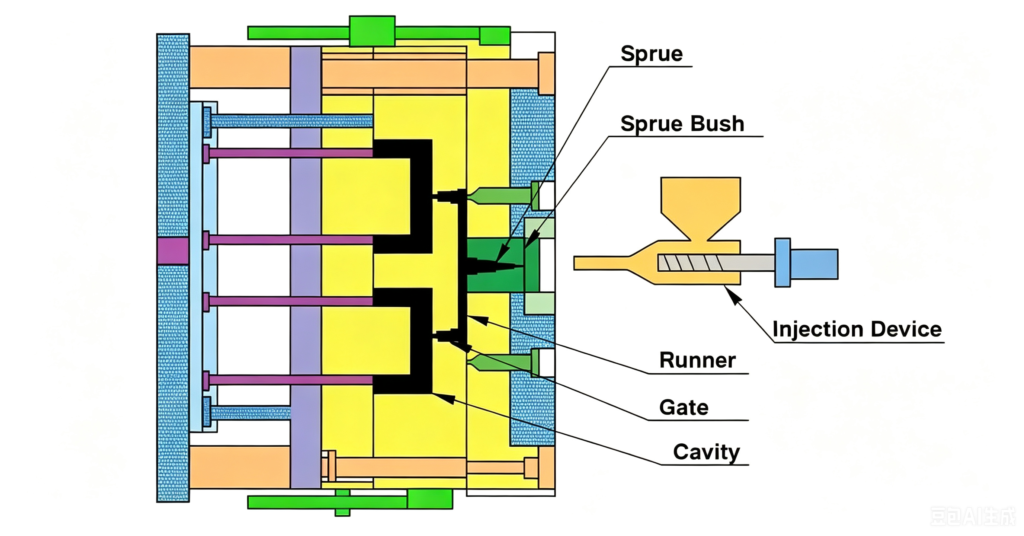
Mold design and manufacturing is the engineering process of creating precision tooling used to
manufacture identical parts through injection molding, die casting, compression molding, or other forming
processes.
A high-quality mold ensures:
• Excellent dimensional accuracy
• Superior surface finish
• Stable production performance
• Longer mold service life
• Lower manufacturing costs
• Faster production cycles
Professional mold makers combine CAD engineering, CNC machining, EDM technology, and quality
inspection to manufacture tooling capable of producing millions of consistent parts.
1Why Precision Mold Design Matters
Many production issues originate during the design stage rather than manufacturing.
A professionally engineered mold helps manufacturers:
• Reduce product defects
• Shorten production cycle time
• Improve mold cooling efficiency
• Increase production capacity
• Reduce maintenance costs
• Extend mold lifespan
Design optimization also minimizes common molding defects such as flash, sink marks, weld lines, air traps,
and warpage.
Complete Mold Manufacturing Process
1. Product Design Analysis (DFM)
Every successful project begins with Design for Manufacturability (DFM).
Engineers evaluate:
• Part geometry
• Draft angles
• Wall thickness
• Undercuts
• Material shrinkage
• Tolerance requirements
The goal is to optimize the product before mold production begins.
2. Mold Engineering
Using professional CAD and CAE software, engineers develop the complete mold structure, including:
• Parting line design
• Core and cavity design
• Gate system
• Runner layout
• Cooling channels
• Ejection system
2• Venting design
Mold flow simulation helps predict filling behavior before steel cutting begins.
3. Precision CNC Machining
Modern mold manufacturers use high-precision CNC equipment to machine mold components.
Typical processes include:
• 3-axis CNC milling
• 5-axis CNC machining
• High-speed machining (HSM)
• Precision drilling
• Surface finishing
High-speed CNC machining delivers superior accuracy while reducing machining time.
4. EDM and Wire EDM Machining
Complex mold geometries often require Electrical Discharge Machining (EDM).
EDM is ideal for:
• Deep ribs
• Sharp internal corners
• Fine textures
• Complex cavities
Wire EDM is commonly used to manufacture inserts, sliders, punches, and precision components.
5. Heat Treatment and Surface Finishing
To improve durability, mold components undergo heat treatment before final finishing.
Common finishing processes include:
• Mirror polishing
• Sandblasting
• Chemical texturing
• Laser engraving
• Surface coating
3These processes improve wear resistance and enhance product appearance.
6. Mold Assembly and Testing
After machining, every component is carefully assembled.
Manufacturers perform mold trials to verify:
Dimensional accuracy
Product appearance
Cycle time
Cooling efficiency
Part ejection
Mold stability
Multiple trial runs help optimize performance before mass production.
Materials Used in Mold Manufacturing
The choice of mold steel depends on production volume, plastic material, and product requirements.
Common materials include:
Mold Steel
Typical Applications
P20
General plastic molds
718H
Consumer products
H13
High-temperature molds
S136
Optical and medical products
NAK80
High-polish cosmetic parts
SKD61
Die casting molds
Selecting the correct steel significantly extends mold life and reduces maintenance.
4Industries That Use Precision Molds
Precision molds are widely used in:
• Automotive components
• Consumer electronics
• Medical devices
• Home appliances
• Packaging
• Aerospace
• Industrial equipment
• Electrical products
• Smart home devices
As manufacturing automation continues to grow, demand for high-precision tooling continues to increase.
Quality Control in Mold Manufacturing
Professional mold manufacturers implement strict quality control throughout production.
Inspection methods include:
• Coordinate Measuring Machine (CMM)
• 3D optical scanning
• Hardness testing
• Surface roughness measurement
• First Article Inspection (FAI)
• Mold trial validation
Comprehensive inspection ensures every mold meets customer specifications before shipment.
Why Choose a Professional Mold Manufacturer?
An experienced mold manufacturer provides more than machining services.
Benefits include:
• Engineering support
• Design optimization
• Rapid prototyping
• Precision CNC machining
• Mold flow analysis
5• Quality inspection
• Fast delivery
• After-sales technical support
Working with an experienced supplier reduces project risks and improves overall manufacturing efficiency.
Frequently Asked Questions
How long does mold manufacturing take?
Most injection molds require 3–8 weeks, depending on complexity, size, and tooling requirements.
What is the typical mold life?
Production life ranges from 100,000 to over 1,000,000 shots, depending on the steel grade, plastic
material, and maintenance.
What industries benefit from precision mold manufacturing?
Automotive, medical, electronics, aerospace, consumer goods, industrial equipment, and packaging
industries all rely on precision molds.
Conclusion
Precision mold design and manufacturing are the foundation of efficient, high-quality production. From
engineering and CNC machining to EDM processing and final inspection, every stage influences the
performance, reliability, and lifespan of the mold.
Choosing an experienced manufacturing partner helps reduce production costs, improve product quality,
and accelerate time to market.
Whether you need prototype tooling, low-volume production molds, or high-volume injection molds,
investing in professional mold engineering is essential for long-term manufacturing success.